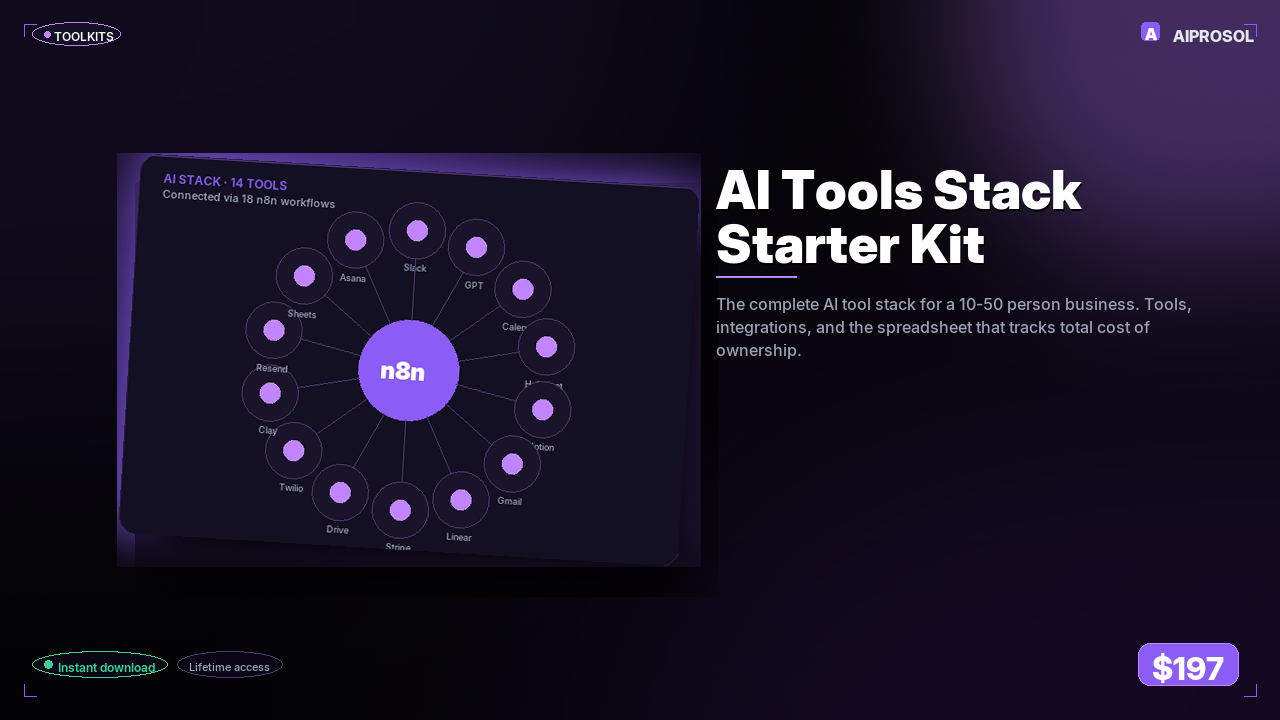
Most teams pick AI tools one panic at a time. Support is drowning, so someone buys Intercom. A deal slips, so someone adds a CRM. Six months later you're paying for nine tools that half-overlap, none of them talk to each other, and nobody can tell you what the whole thing costs. This kit exists so you skip that.
Inside are eight pre-built stacks, each matched to a real business shape: the 8-person services agency, the post-seed SaaS startup, the 30-person D2C brand, the 50-person professional services firm, the solo operator, the manufacturing SMB, the real estate brand, the healthcare ops team. Find the one closest to yours and you're most of the way there.
Every stack is laid out the same way, so there's no guessing. You get the tool for each layer (LLM, workflow runner, CRM, support, calendar, coding, voice) with the actual monthly cost next to it and a total at the bottom. The 8-person agency stack lands at $536/mo. The 12-person SaaS startup at $1,136 plus variable API spend. Real numbers you can take to whoever signs off on spend, not "it depends."
But the tool list is the easy part. The part teams get wrong is the rationale: why Make and not Zapier at your run volume, why HubSpot Free until you actually need pipeline reporting, when self-hosted n8n starts paying for itself. Each stack tells you why these picks and not the obvious alternatives, so when someone on your team pushes back you have an answer.
Start with one thing, not nine
You don't build the whole stack in week one. Every section names the single automation to build first and why it's the one that pays for the rest. For the services agency that's an inbound-enquiry classifier that routes each lead to the right partner. It covers the cost of the entire stack inside 30 days. For the SaaS startup it's a support-email classifier that decides what gets an AI answer and what reaches a person. Build that, see it work, then add the next one.
Each stack also carries scale-up triggers, the specific revenue or headcount lines where a tool stops fitting. When inbound volume outgrows your reps, add a voice agent for qualifying. Past 25 people, the case for migrating off Make to self-hosted n8n flips. You're not just buying a snapshot of what to use today, you're getting the map of what to change as you grow, so the stack ages with the business instead of against it.
Every stack here was assembled and run inside real Aiprosol client work. Costs and tools are accurate as of release. Pair it with the AI Tools Comparison Guide if you want the full reasoning behind each individual pick; this kit is the part where you stop comparing and start wiring.