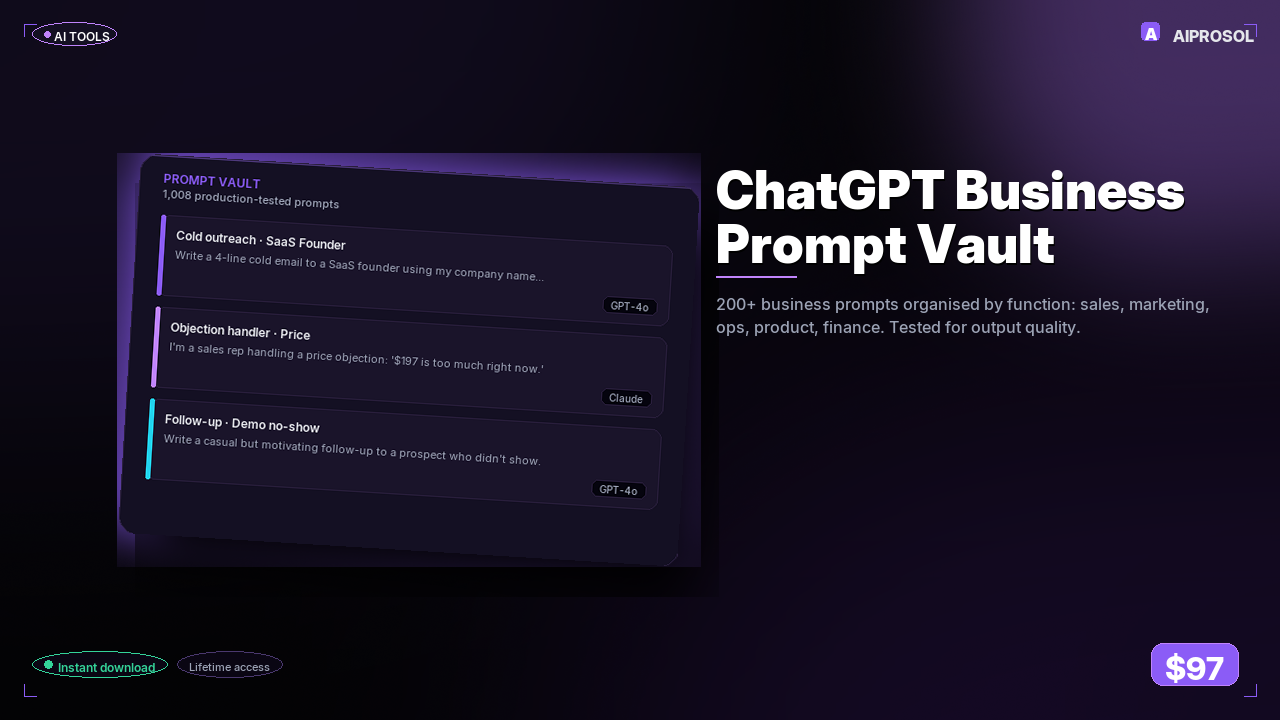
Most prompt libraries are screenshots of someone's lucky afternoon. You paste one in, it works once, and the next time you need it you're rewriting from memory. This vault is the opposite. Every prompt has been run against real work, stripped of the parts that produce mush, and written down so you get the same output on Tuesday that you got on Monday.
Each one is built the same way: a ROLE the model plays, the TASK it produces, the CONTEXT you fill in (the bits in curly braces), a FORMAT that pins down length and structure, and GUARDRAILS that say what it must not do. That last part is the one almost nobody writes, and it's where half the quality lives. The cold-email prompt, for instance, casts the model as a senior SDR who has personally booked 800 meetings, caps the subject at seven words and the body at ninety, demands one specific reference to something the prospect did recently, and then flatly bans "circling back," "synergy," and opening with "we." You fill in five fields. You get an email a person would actually answer.
The same discipline runs through all eight parts. Sales covers discovery agendas built from a prospect's own website copy, an objection handler that returns three calibrated replies and tells you which to use, proposal redlines, pipeline triage. Operations turns a recurring email thread into a written SOP, pulls assignees and dates out of a meeting transcript, and produces a renew-renegotiate-drop call on a vendor. Then marketing, customer success, finance, HR, product and engineering, and leadership, each with prompts written for the work you actually do, not novelty.
How you use it
Three rules and you're running. Paste the whole prompt, don't paraphrase it. Replace every variable before you hit send. Then, when the answer comes back, ask the model to critique its own weakest paragraph and rewrite it. That last move is ninety seconds and routinely lifts quality by half again or more.
You get the prompts five ways: 200 structured in JSON with an id, category, the system and user template, a best-model note, and tester notes; the same set as CSV; an indexed Markdown file for browsing; and a printable Markdown and HTML guide with 76 more prompts inline. The JSON is the part power users care about. It forks cleanly into your own internal prompt repository, and the quarterly additions over the next year land in a separate folder so nothing you've customized gets overwritten.
Everything was tested on GPT-4o, Claude Sonnet 4.5, and Llama 3 70B, so it isn't tied to one vendor. The library is licensed for unlimited use inside your organization, including your own internal tools and customer-facing work. Buy it once, fork it, and stop rebuilding the same prompt every quarter.