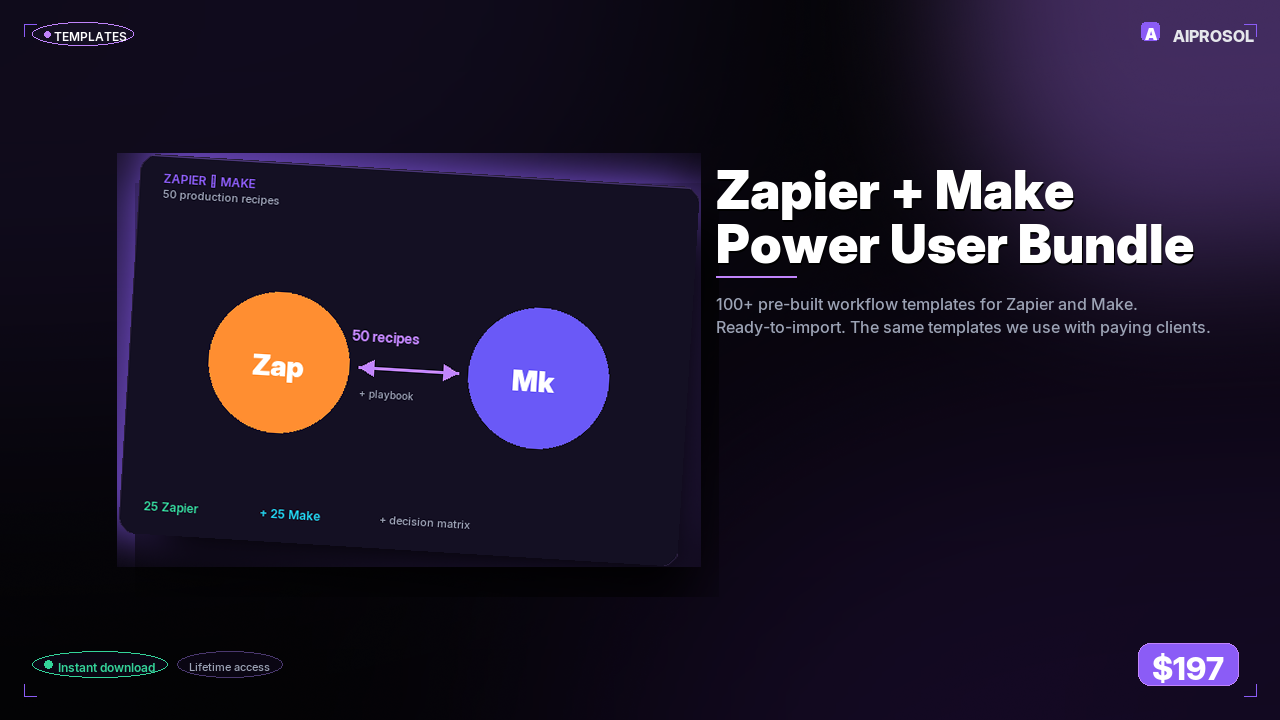
If you've run Zapier or Make for six months, you've already hit the wall. The five-step linear zap works fine until the day a lead comes in with a free email address and needs different routing, or a renewal alert has to fire at 60, 30, and 7 days, or a workflow shows green in the run history while the destination quietly rejected every record. This bundle is for that point. It assumes you know the basics and want the patterns that hold up once the logic gets real.
It opens with the question most people answer wrong: Zapier or Make? The decision tree gives you four honest verdicts instead of a sales pitch. Pick Zapier when you're solo and a five-minute learning curve beats a 5x cost saving, or when the integration you need is in Zapier's larger catalogue and nowhere in Make's. Pick Make when you need to debug (its visual scenario diagram beats Zapier's run history every time), when there's branching or looping involved, or once volume climbs past roughly 2,500 operations a month and the pricing starts to favor it. There's also a "pick both" pattern (a front-office runner calling a back-office runner over webhooks) and a "pick neither" line, because past about 50,000 operations a month the math tips toward n8n or actual code, and pretending otherwise would cost you money.
What's actually inside
Twenty-five advanced Zapier recipes and twenty-five Make scenarios, each written as a build guide: the trigger, the steps, the thing that makes it tricky, and the error you'll hit if you skip it. The Zapier side covers Paths (with the regex trap that catches `johnsmith@gmail.com.au` instead of letting it slip through a naive "contains gmail.com" filter), sub-zaps for DRY logic, the Looping step that quietly bills each iteration as a separate task, JavaScript code steps, Webhooks, and Storage for remembering whether you've seen a lead before. The Make side leans on what Make does well: the Iterator plus Aggregator pair, Routers with fall-through, the five error-handler strategies (ignore, break, resume, rollback, commit), the Code module, and Data Stores for dedupe and caching.
Ten of the highest-value Make scenarios ship as importable `.json` blueprints, so you drop them in and map your own connections. Zapier has no import format, so its twenty-five are step-by-step guides you assemble in your own account. That's deliberate. Saved configurations rot when a SaaS API shifts under them; the patterns and the gotchas are what stay useful.
Then there's the part you'll come back to most: a six-step debugging playbook (did the trigger fire, did the data shape change, is auth still valid, are you rate-limited, did the AI step return the format you asked for, did the destination accept it), plus cost-optimisation patterns and migration paths for when you outgrow a tool. Build each recipe in five to fifteen minutes. Keep the matrix open while you decide.