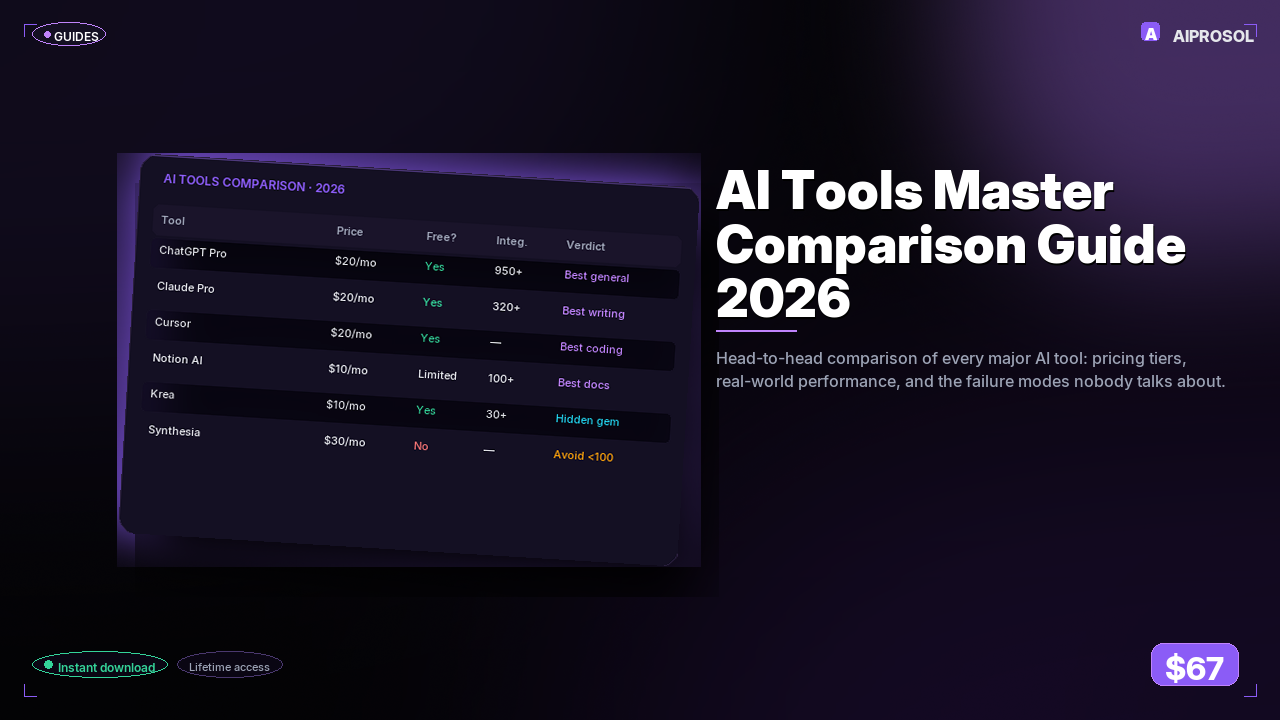
Most "best AI tools" lists are written by people who get paid when you click a link. This one isn't. It's the internal reference we actually use to decide what drives our own work, cleaned up enough to hand to you. Sixty-plus tools, nine categories, and a verdict on each one that we'd stand behind in a planning meeting.
The hard part of choosing AI tooling isn't finding options. It's that every option's own landing page tells you it's the best, the pricing is built to look cheaper than it is, and half of what was true last quarter is wrong now. So the guide is built to survive that. Every tool gets the same five fields, no exceptions, so you can read across them instead of squinting at marketing pages.
The five fields, and why they're the only ones
Best for is the single job a tool is the most-correct answer to, not the ten it claims. Cheapest credible plan is what you actually pay to use it for real work, not the headline number that assumes you never hit a limit. One thing it does better than anyone is the reason to buy it at all. One reason not to pick it is the gotcha we'd warn a colleague about. And the Aiprosol verdict is a flat call: use today, watch list, or avoid for now. No fence-sitting.
A couple of those verdicts will probably annoy a vendor. Intercom Fin gets a green light if you're already on Intercom and a red one if you're not, because per-resolution pricing that looks fine in a demo gets frightening at volume. DeepSeek V3 is genuinely close to frontier quality at a tenth of the cost, and we still say pilot it for back-office work only and keep customer data off it until legal has looked. That's the kind of distinction the affiliate lists skip.
Start at the decision flowchart on the first page. It routes you by what you're actually trying to do. Generating long-form text or code sends you to foundation models. Answering customer queries goes to support platforms. Wiring apps together goes to workflow automation, running voice calls to voice agents, and so on through documents, images, agents, and data. You don't read this front to back. You jump to the two or three sections that match the problem on your desk this week.
Foundation models come first because that choice quietly drives everything downstream, so it's worth getting right and changing last. From there it's a working catalogue you keep open in a tab, not a report you read once. Prices and capabilities are current as of release; buyers get the quarterly refresh free, because a tools guide that doesn't get updated is just a museum piece.