Most automation guides are one of two flavours. The first walks you through Zapier screen by screen. Helpful on day one, useless the moment your needs outgrow the tool. The second promises that AI will run your whole company. Inspiring, and no help at all when you actually need to ship a working invoice-routing workflow on a Tuesday.
This is the third kind. It's the thinking we use inside Aiprosol before we touch a single node: the principles that decide whether an automation survives contact with reality, the handful of shapes every workflow actually takes, the failure modes that look fine in a demo and quietly cost you money in production, and 25 templates you can import and run today.
It's written for the people who carry the pager. Ops leads, COOs, founders, and the engineer who got handed "make this automatic" running businesses somewhere between 10 and 200 people.
Start with the rules, not the tool
A few principles do most of the work. One workflow does one job, because the day your everything-handler breaks, you won't know whether it was the form, the lookup, the CRM, or the Slack post. Every workflow needs an observable success state, so "I think it's running" is never a sentence anyone has to say. Failure is data: retry with backoff, then post the failing payload to an errors channel, then halt loudly. Silent failure is worse than no automation, because it builds confidence in a system that isn't actually doing the work. And idempotency isn't optional, because webhooks fire twice and humans re-run things, and the same input should always produce the same outcome.
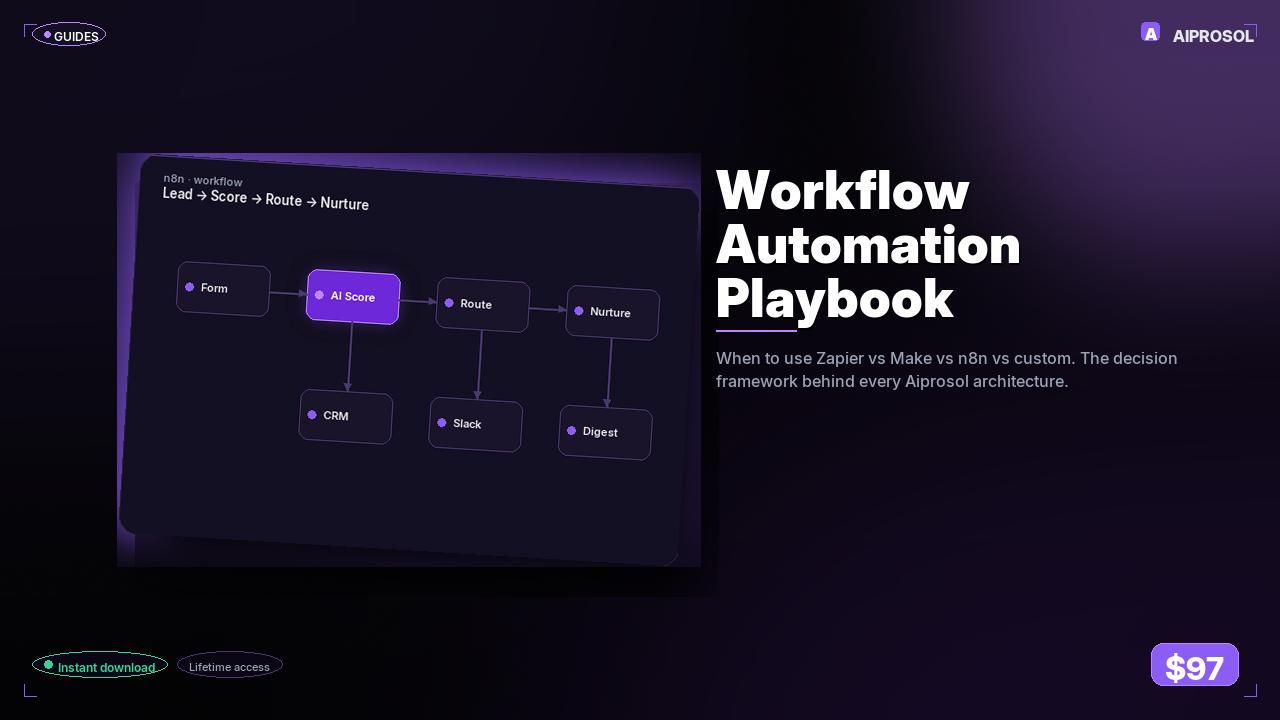
Get those right and the rest is shape-matching. Almost everything in production is one of seven patterns, or a couple of them chained together: linear pipelines, branching conditionals, fan-out, scheduled sweeps, polling wrappers, approval gates, and long-running jobs. Once you can name the shape, the "complicated" workflow on your whiteboard usually collapses into one or two of them, and the tool choice gets obvious.
Which is the other thing this answers. When does Zapier earn its keep, when does Make's visual filtering win, and when do you self-host n8n because the cost-per-run gap is 4x at your volume? There's a selection grid for that, built around volume and workflow shape rather than feature checklists.
The back half is the part you'll keep open. Twenty-five importable n8n templates across sales, customer success, operations, finance, marketing, and people, each one a worked example of the patterns instead of a toy demo. Five anti-patterns to recognise before they bite. A 23-question operator's checklist to run before anything goes live, and a six-step map for turning a manual process into a workflow you can trust.