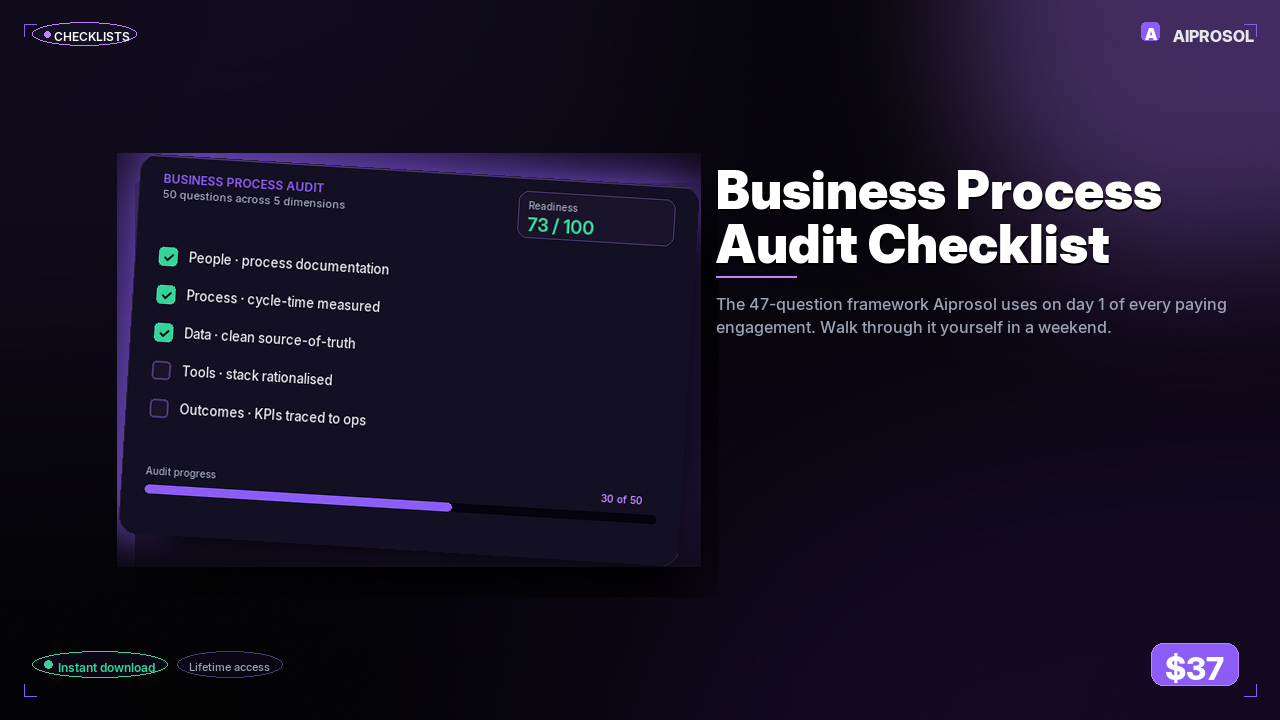
Most of the work that's quietly draining your week isn't hard. It's just repetitive, predictable, and still being done by a person. Someone retyping a form submission into the CRM. Someone copying invoice totals into the accounting system. Someone manually nudging a deal that's gone quiet. None of it shows up as a line item, so nobody ever decides to fix it. It just sits there, costing 30 to 90 minutes a week, every week, forever.
This is the checklist we open on day one of every paying engagement. We hand it to you to run yourself, in one focused sitting.
What you're actually doing
Block off 90 minutes. Pull your last full month's bank or accounting export so you can see where the money actually goes, and have your busiest inboxes and shared drives open. Then you walk through seven areas of the business and score each one honestly on a 1 to 5 scale: lead intake and qualification, sales pipeline, customer onboarding and delivery, document processing and data entry, inbox and comms triage, reporting and KPIs, and recruiting and internal ops.
The questions are deliberately specific, because vague questions get vague answers. Not "is your sales process good," but: does every form submission become a CRM record with no human typing? Do stale deals auto-flag after N days of silence? When a contract is signed, does the customer get a welcome packet inside 60 seconds, or does someone remember to send one? Every "no" is a candidate.
After the seven areas there's a five-question pressure test that catches what scoring misses. The most useful one: if you took three weeks off starting tomorrow, what fires would start? Each fire is a brittle process leaning on one person's attention.
What you walk away with
Two versions ship together. There's the document you write in, and an interactive HTML version you open in any browser. The HTML one auto-scores as you go, draws a bar per business area with a tier badge, points you at the single weakest area, and maps it to the Aiprosol product built for that exact problem. You can export the whole thing as JSON to share or to re-run next quarter and watch the numbers move.
The rule we use throughout is simple. If a process is predictable, meaning the same inputs produce the same outputs, and it recurs more than once a week, it's an automation candidate. By the end you'll have a ranked shortlist of those candidates and a rough read on what each one costs you today, scored against effort so you know what to tackle first.
You don't need us to run this. That's the point. Spend the weekend, and you'll know exactly where your business is leaking time, in priority order, before you spend a cent on fixing it.